
Your McLaren Threw a Warning and the Code Reader Said Nothing — Here’s Why
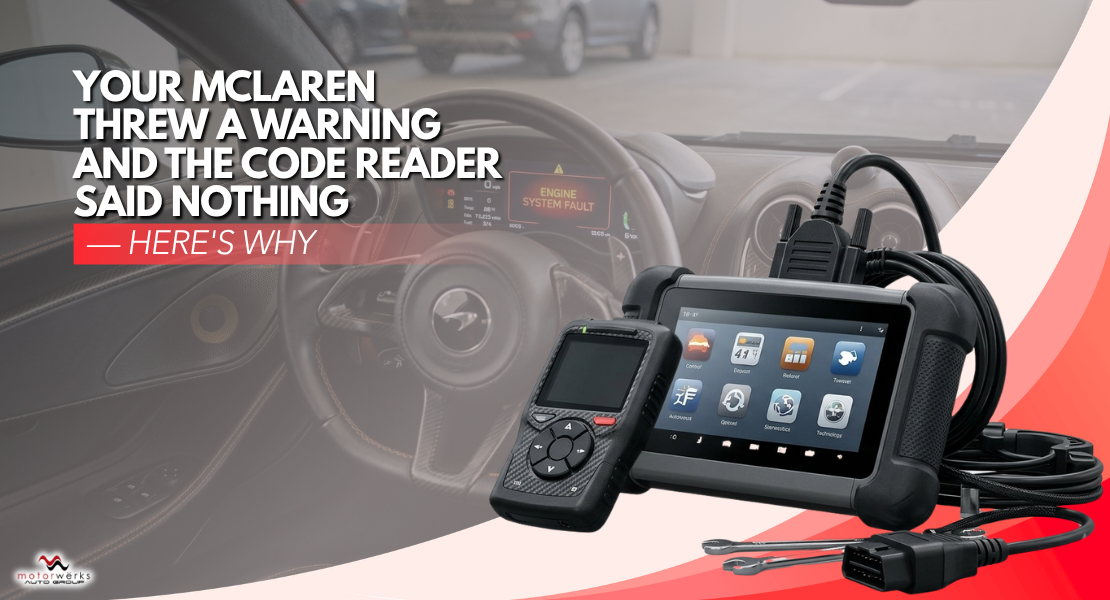
A yellow message appears on the dash of a 570S somewhere on the Grand Parkway. You plug in the code reader you keep in the frunk. It reports no faults, cheerfully, while the car is clearly unhappy.
The reader is not broken. It simply cannot see most of the car. A cheap OBD tool reads emissions data, because that is all federal law requires a car to publish. The chassis, hydraulic suspension, gearbox and body modules on a McLaren or Ferrari keep their faults in a manufacturer-only language, and our Humble shop is the only one in the area running the factory McLaren and Ferrari diagnostic software that speaks it.
Quick Summary: Key Takeaways
- Generic scanners read one slice: OBD-II was built for emissions, so chassis, gearbox and body faults stay hidden.
- Factory software sees the whole car: It reads every module, commands components and shows live data a generic reader never receives.
- We hold the real thing: Our shop is the only one in the Humble area with OEM McLaren and Ferrari diagnostic software.
- Clearing a code is not a repair: It deletes the evidence and resets the readiness the county inspection needs.
- Harris County still inspects: Gasoline vehicles two to twenty-four model years old need an annual emissions inspection here, exotics included.
OBD-II Was Designed for Emissions, Not for Supercars
The standardized port under your dash exists for one reason: air quality regulation. It publishes a fixed set of powertrain and emissions codes in a common format so any state inspection lane can read any car.
Everything else was left to the manufacturer. Gearbox strategy, active aero, hydraulic suspension, brake-by-wire, the proprietary electrical architecture on a Lamborghini — none of that is covered by the standard, so none of it appears on a generic tool.
Which is why the reader said nothing. It looked in the only room it has a key for, found that room tidy, and told you the house was fine.
What Factory Software Shows That a Parts-Store Reader Cannot
Depth is the difference. The factory tool enumerates every control module on the car, pulls stored and pending faults from each, and reports the freeze-frame conditions that were present when the fault set — road speed, temperature, gear, pressure.
It also lets us push back. We can command a hydraulic valve, cycle a pump, calibrate a sensor after replacement, and watch live data streams at a resolution that turns an intermittent complaint into a measurement.
That matters most on the faults that never repeat in the bay. An intermittent gearbox message with no freeze-frame data is a guess, and guessing on an exotic gets expensive in a hurry.
Clearing the Code Is the Most Expensive Free Thing You Can Do
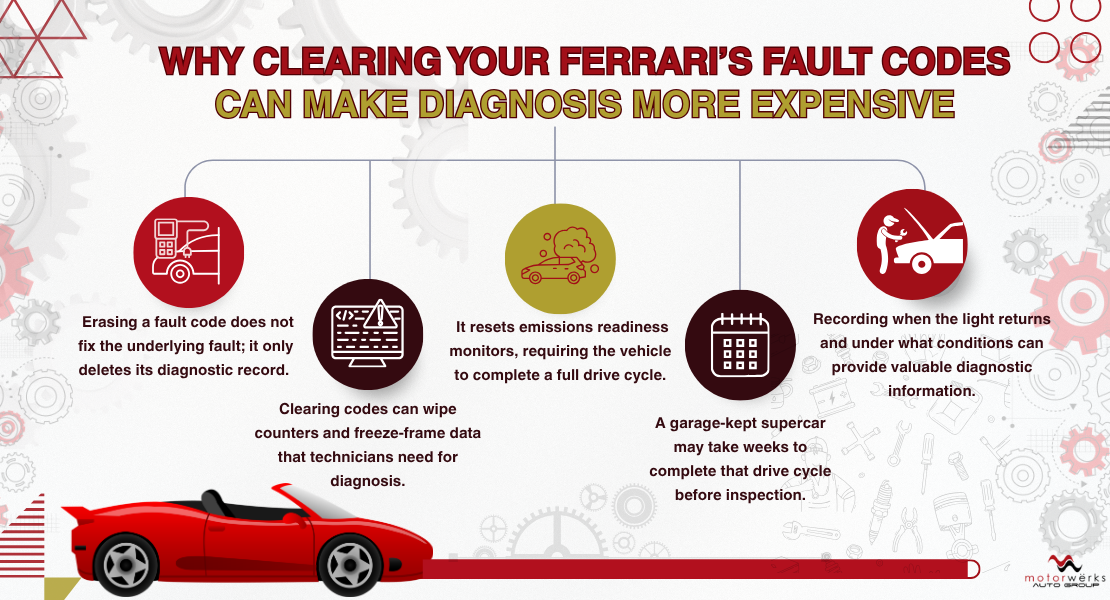
Erasing a fault does not fix a fault. It deletes the record of when and how the problem happened, and on most systems it also wipes the counters and freeze-frame data a technician would have used to find it.
Then there is the emissions side. Clearing codes resets the readiness monitors, which means the car has to complete a full drive cycle before it can pass an inspection, and a supercar that lives in a garage may take weeks to get there.
If the light comes back, note the conditions. Cold or hot, first start or after an hour, hard cornering or straight-line — that detail is worth real money at the counter.
The Faults We See Most Often on Low-Mileage Exotics
Cars that sit produce electrical faults, not mechanical ones. A battery that drifts down over three weeks in a garage drops system voltage below what the modules expect, and the wake-up produces a screen of warnings that have nothing to do with the actual problem.
Heat does the rest. A Houston summer bakes connectors, cooks sensor wiring near exhaust runs, and stiffens the rubber boots that keep moisture out, so autumn is when the stored faults from July finally start setting warnings.
Our habit is boring and it works. Charge the car properly, confirm system voltage under load, then read every module before touching a single part.
Humble and Kingwood Owners Still Have an Inspection to Pass
A stored fault is not just an annoyance here. The Texas Commission on Environmental Quality states that gasoline vehicles two to twenty-four model years old need an annual emissions inspection in Harris County, with 1996-and-newer vehicles tested through the on-board diagnostic port. That is the same port your stored fault lives in.
That includes the fun cars. A Lamborghini that only comes out on cool weekends needs the same sticker as the daily driver, and the drive cycle after a code clear does not complete itself in a garage.
We are on Rotary Drive in Humble, twenty minutes from Kingwood and The Woodlands, and we work on Aston Martin, Audi, Bentley, BMW, Ferrari, Jaguar, Lamborghini, Land Rover, Maserati, McLaren, Mercedes, MINI, Porsche and Rolls-Royce.
Frequently Asked Questions
Q: Can a regular OBD2 scanner read McLaren fault codes?
A: Only the emissions-related ones. A generic scanner reads the standardized powertrain codes every car must publish, but McLaren's chassis, hydraulic suspension, gearbox and body modules store their faults in manufacturer-specific formats that require the factory diagnostic software.
Q: What does factory diagnostic software do that a generic tool doesn't?
A: Three things. It reads every control module on the car instead of one, it captures the conditions present when a fault set, and it lets a technician command components and run calibrations. That combination is what turns an intermittent warning into a specific part.
Q: Is it bad to clear a check engine light before an inspection?
A: Yes. Clearing the code resets the readiness monitors, and an inspection will reject a car whose monitors are not complete. You also lose the stored data that would have identified the fault, so the light usually returns before the sticker does.
Q: Why do warning lights appear on an exotic that has barely been driven?
A: Low system voltage. A car that sits for weeks lets the battery drift down, and modules that wake up on marginal voltage set communication and range faults across the network. Proper charging before startup prevents most of it.
Get the Real Fault Read Instead of the Emissions Summary
Bring the car in with the light on if you can. Reading every module with the factory software takes an hour and it replaces guesswork with a part number.
Motorwerks Auto Group — 2006 Rotary Dr, Humble, TX 77338
Hours: Mon-Fri 9:00 AM-1:00 PM and 2:00 PM-6:00 PM; closed 1:00-2:00 PM; Sat-Sun closed
Website: motorwerksag.com