
Before the Light Bar Goes On, Work Out What the Alternator Can Give You
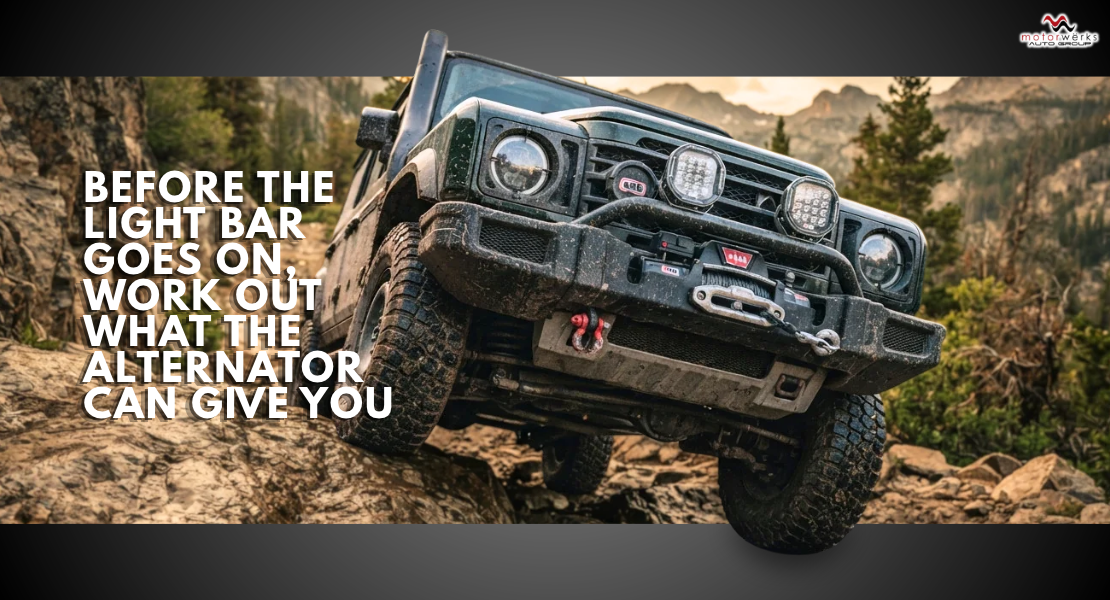
Texas is specific about what you may hang on the front of a truck. The Transportation Code allows no more than two fog lamps, mounted 12 to 30 inches off the ground, and no more than two auxiliary driving lamps, mounted 16 to 42 inches up. A fog lamp left of center also has to be aimed so that at 25 feet no part of its bright beam sits higher than four inches below the middle of the lamp. Factory lighting is engineered around limits like those. Aftermarket lighting had no such pressure applied to it, and a badly chosen, badly aimed bar will blind oncoming drivers on 59 and still leave you squinting on a dark lease road.
Glare is only half the question, though. The other half is electrical, and it is the half most builds skip.
Quick Summary: Key Takeaways
- Add up the amps before you buy: lights, a compressor, a fridge and a winch are not a rounding error on a 12-volt system.
- A winch is a short, violent load: sizing for its peak draw matters more than its rated pull.
- The charging system has a ceiling: the alternator was specified for the factory build, not yours.
- Grounds and fuses are where cheap kits fail: undersized returns cook wiring long before a fuse notices.
Do the arithmetic first
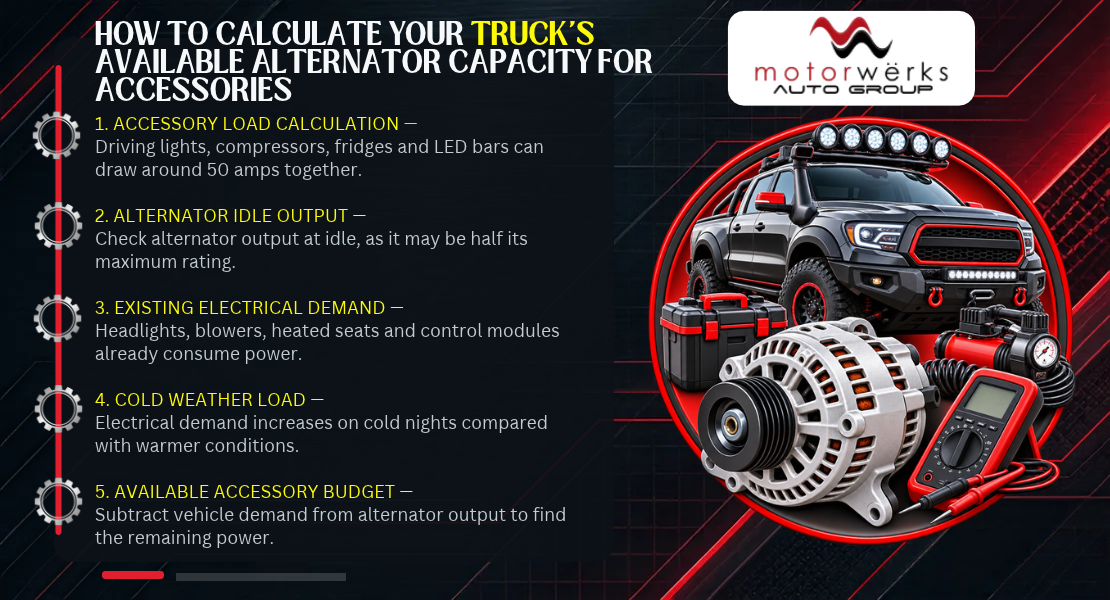
A pair of driving lights might pull 8 amps. A compact air compressor adds 25 or more while it is running. A dual-zone fridge cycles at 5 to 7. An LED bar can take 15 on its own. None of them sounds like much, and together they can peak in the region of 50 amps with the engine idling at a trail head.
Fifty amps is a real fraction of what a standard alternator produces. The figure that matters is output at idle, because the headline rating on the box was measured at 3,000 rpm. Many units give barely half their maximum when the engine is just ticking over.
Then subtract what the vehicle already needs. Headlights, the heater blower, heated seats, the fuel pump and a dozen control modules are drawing before a single accessory is switched on, and on a cold night that baseline is higher than it was in August. Whatever is left over is your real accessory budget, and it is smaller than the alternator's sticker suggests.
A winch is a different kind of load
INEOS lists an optional Red Winches unit on the Grenadier that will pull up to 12,125 pounds, and recovery hardware in that class can draw several hundred amps when it is working hard.
No alternator on a production vehicle is sized for that, so the battery covers it and the charging system spends the next twenty minutes putting the charge back.
Which means the recovery plan is really a battery plan. Cable gauge, terminal quality and the state of the battery decide whether a hard pull works or whether the truck browns out mid-recovery with the engine running. Short pulls with cooling breaks between them are far kinder to the whole system than one long haul, and they are easier on the winch motor as well.
Why cheap kits fail at the ground, not the switch
Wiring harnesses sold with accessory lighting are usually generous on the positive side and mean on the return. Current has to come back, and an undersized ground or a self-tapping screw into painted body metal is a high-resistance joint that heats up every time the circuit is used.
Three habits fix most of it. Fuse each circuit at the battery, not at the device, so a chafed wire cannot heat up along its whole length before anything blows. Ground to a clean, prepared stud instead of whatever panel is nearest. And use a relay, so the dashboard switch carries a signal and the heavy current stays in short, thick cable near the battery.
Routing deserves the same care. Wiring that crosses a hinge, a suspension link or a hot exhaust will eventually chafe through, and on a vehicle that articulates properly off-road the slack has to be calculated at full droop, not at ride height in the shop.
Watch what the extra load does to everything else
Modern Land Rovers and the Grenadier monitor battery state constantly and will start shedding functions when they decide capacity is low. Owners read that as a new fault, when the truck is simply responding to a load nobody told it about.
Short winter days around Humble, Kingwood and Atascocita mean lights run more hours, and a build that behaved all summer can start throwing messages once headlights, heated seats and a fridge overlap on the same journey.
Aiming is the last job and the one most often skipped. A bar set level with the hood throws its hottest beam straight into the eyes of oncoming traffic, while the same bar angled slightly down puts that light on the road where it is useful. Set it against a wall at a measured distance, with the vehicle loaded the way it will actually be loaded, and check that the road-legal lighting still meets its own aim after a lift kit has changed the vehicle's attitude.
Plan the Build Around the Charging System
Talk through the accessory list before the parts arrive, not after the truck comes back with a flat battery. We are at 2006 Rotary Dr in Humble; the full picture of what we build and service is at motorwerksag.com.