
Lamborghini & McLaren Cooling Systems in Houston’s September Heat
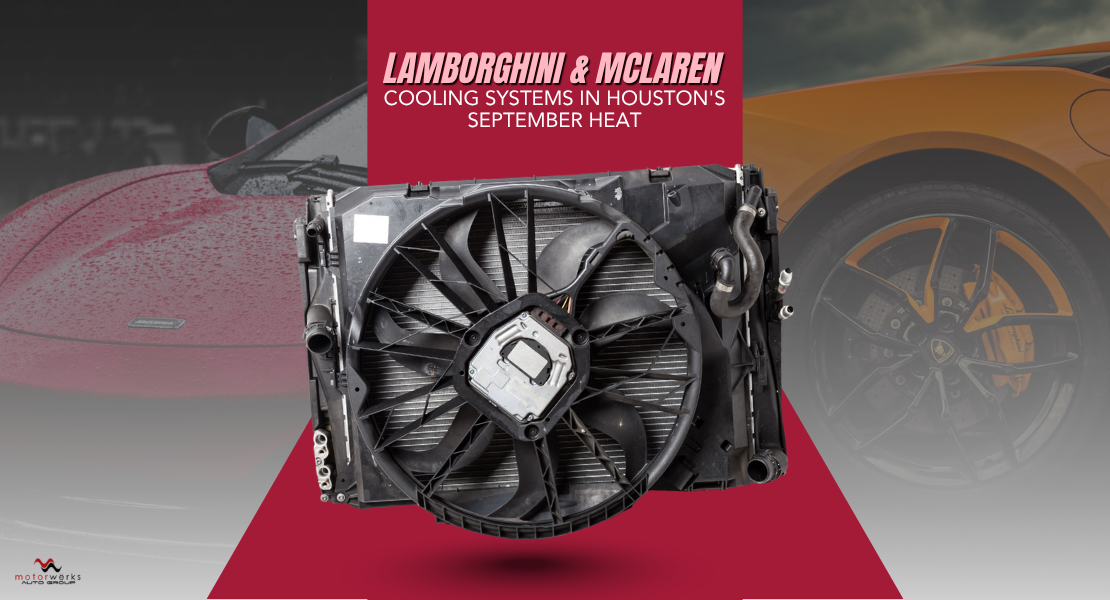
It is 99 degrees on the Eastex Freeway and traffic has stopped near the airport exits. The Huracan's coolant needle climbs where it never climbs on an open road. Ten minutes later, reduced power. Mid-engine exotics hate a Houston September.
Idling makes it worse, since the U.S. Department of Energy calculates that idling burns a quarter to a half gallon of fuel per hour depending on engine size and air conditioning use.
Quick Summary: Key Takeaways
- Side radiators clog with debris: Gallardo, Huracan and Aventador pods pack with leaves and grit.
- Fan modules fail as a pair: Replace both, because the second one is close behind.
- McLaren runs two cooling circuits: The M840T V8 has a separate low-temperature loop and pump.
- Hot in traffic, normal at speed: That is airflow. Not a thermostat or head gasket.
- Service coolant every three to four years: Depleted inhibitors start pinholes in aluminum cores.
Mid-engine exotics cool themselves through ducts, and Houston traffic removes the airflow
A Lamborghini or McLaren has no radiator behind a big front grille, so cooling comes from radiators mounted in the flanks and fed by carefully shaped ducts. Those ducts need speed.
Stop on Beltway 8 in 100-degree air and the entire cooling capacity of a Huracan or 720S depends on electric fans pulling through side cores that were never the primary path. Any restriction there becomes an overheating event.
The heat load is enormous. A 5.2L V10 or a twin-turbo 4.0L V8 rejects serious energy into coolant even at idle, which is brilliant on a track and marginal in a jam.
Clogged radiators, failed fan modules and tired hoses cause most overheating
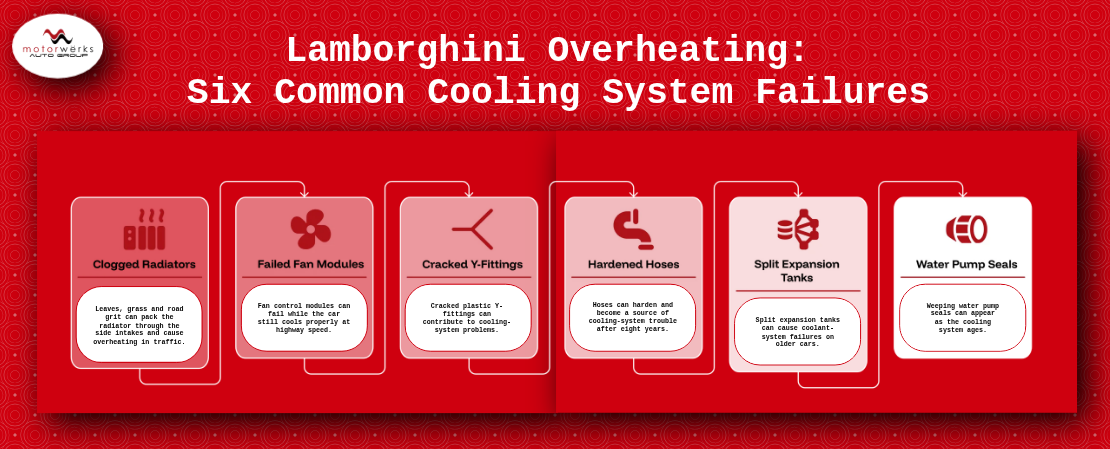
The most common finding on a Lamborghini that overheats in traffic is a debris-packed radiator, since leaves, grass and road grit get pulled straight into the side intakes. Nobody looks there.
Fan control modules come second, and because the car still cools fine at highway speed the failure often hides for months before revealing itself in a backup near Bush Intercontinental. Gallardo and Huracan controllers sit in a hot spot.
Then there is the plumbing. Cracked plastic Y-fittings, hardened hoses, split expansion tanks and weeping water pump seals all show up past eight years. McLaren adds an auxiliary low-temperature pump that can quietly stop.
Read the temperature gauge pattern before you replace parts
The pattern is the diagnosis, so watch when the needle moves, because rising in stopped traffic and falling once you are moving means airflow. That is fans or cores.
Running high everywhere, including on an open highway, means flow instead, which points at the thermostat, the water pump or air trapped in the system. Intake air temperature deserves a look too.
Charge coolers heat-soak in traffic on a twin-turbo McLaren. The ECU pulls timing before the coolant gauge moves, so the first complaint is soft acceleration on a ramp. Sweet vapor at a stoplight usually means a pinhole.
Overheating an exotic engine costs far more than the cooling repair
These engines are aluminum, tightly packaged and expensive to open, and one serious overheat is enough to warp a head or distort a liner. Turbochargers suffer too.
Almost every overheat we investigate traces back to something small: a blocked core, a fan module that had already stored a code, or coolant nobody changed in seven years. None of those were expensive when they started.
Limp mode is a gift. It means the ECU is protecting your engine, and the right response is to stop and call a flatbed. Driving through it is how engines die.
Our Humble shop tests exotic cooling systems with factory software and real measurements
Every cooling job here begins with a pressure test held at specification, then we bring the car to temperature and read radiator inlet and outlet with an infrared thermometer. Cold sections show themselves.
Because we run OEM diagnostic software for McLaren and Ferrari alongside our Lamborghini tooling, we can command fans, read auxiliary pump duty cycle and log temperatures during a road test. Guessing from a dash warning is not diagnosis.
Then we do the unglamorous work. Radiator cores cleaned properly from behind, fan modules replaced in pairs, coolant renewed to the correct specification. We also run cooling inspections for cars stored in Kingwood and The Woodlands. Before the next 100-degree week, ideally.
Frequently Asked Questions
Q: Why does my Lamborghini overheat in traffic but not on the highway?
A: Because side-mounted radiators depend on ram air at speed. In stopped traffic the electric fans do all the work, so a clogged core or failed fan module only shows up when you are not moving. Highway airflow hides the fault.
Q: How often should McLaren coolant be changed?
A: Time, not miles. Every three to four years regardless of mileage, using the specified coolant. Corrosion inhibitors deplete on a time basis rather than a distance basis, and depleted coolant is what starts pinhole leaks in aluminum radiators and charge cooler cores.
Q: What does limp mode mean on an exotic car in hot weather?
A: The engine control module has seen a temperature it will not tolerate and cut power to protect the engine. Do not drive through it. Pull over safely, shut down, and arrange transport so a cooling repair stays a cooling repair.
Q: Can a clogged radiator be cleaned instead of replaced?
A: Often yes. If the cores are sound and only the fin faces are packed, we remove panels, clean from the back and restore most of the airflow. If tubes are corroded or weeping, replacement is the honest answer.
Book a cooling inspection for your Lamborghini or McLaren before the next heat wave
Do not wait for a temperature warning on the Eastex Freeway. Contact our Humble shop for a pressure test, radiator inspection and fan function check before your next drive.
Motorwerks Auto Group - 2006 Rotary Dr, Humble, TX 77338
Hours: Mon-Fri 9:00 AM to 6:00 PM; closed weekends
Website: motorwerksag.com