
Porsche MAF Sensor Failure: What Humble Drivers Need to Know
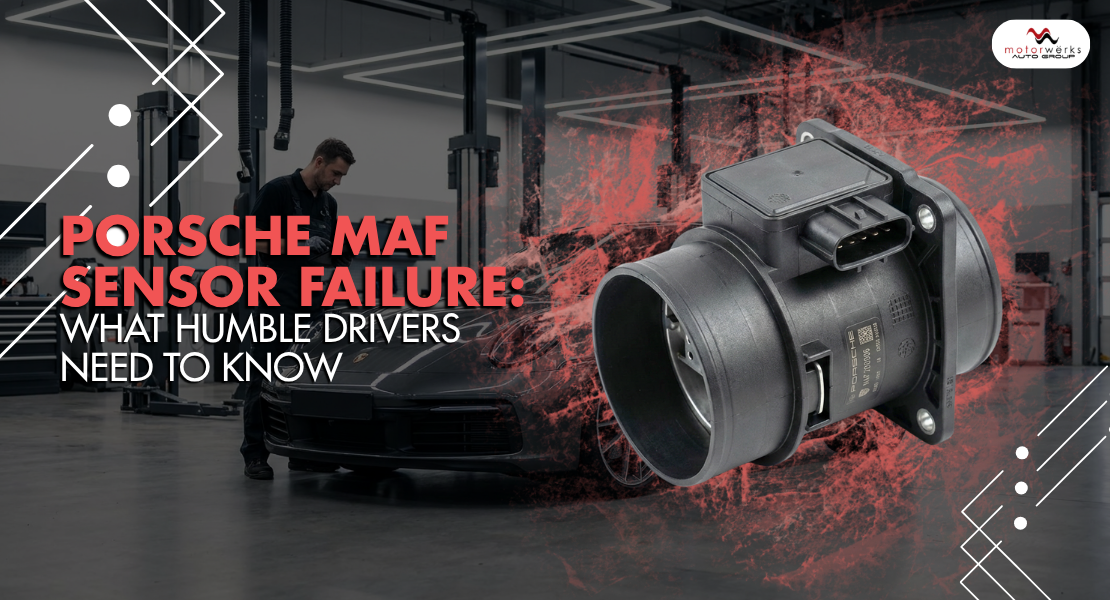
Porsche engineering is built around precision — precise power delivery, precise throttle response, and a precise balance between performance and efficiency. The mass airflow sensor, commonly called the MAF sensor, is one of the key instruments that makes that precision possible. Located in the intake air path between the air filter and the throttle body, the MAF sensor measures the exact volume and density of air entering the engine and feeds that data to the ECU in real time. When the MAF sensor begins to fail, your Porsche's engine management can no longer calculate accurate fuel delivery, and the result is performance that falls well short of what you paid for. At Motorwerks Auto Group in Humble, we diagnose and repair Porsche MAF sensor issues regularly, and we want drivers to understand what to watch for. Contact us to schedule an appointment with our Porsche mechanics today!
How the MAF Sensor Works in a Porsche
The MAF sensor on modern Porsche models uses a heated wire or hot-film element that is cooled by incoming air — the degree of cooling is used to calculate air mass flow. This signal is sent to the Porsche DME (Digital Motor Electronics), which cross-references it with throttle position, RPM, and other inputs to calculate the ideal fuel injection quantity and timing. The system operates within extremely tight tolerances because Porsche engines — whether naturally aspirated flat-sixes, turbocharged flat-fours, or PDK-equipped performance models — require precise air-fuel ratios to deliver the performance and emissions characteristics they're designed for. Any deviation in MAF sensor output directly affects how the DME commands fuel delivery, which is why MAF failures tend to produce such noticeable performance symptoms.
Common Symptoms of a Failing Porsche MAF Sensor
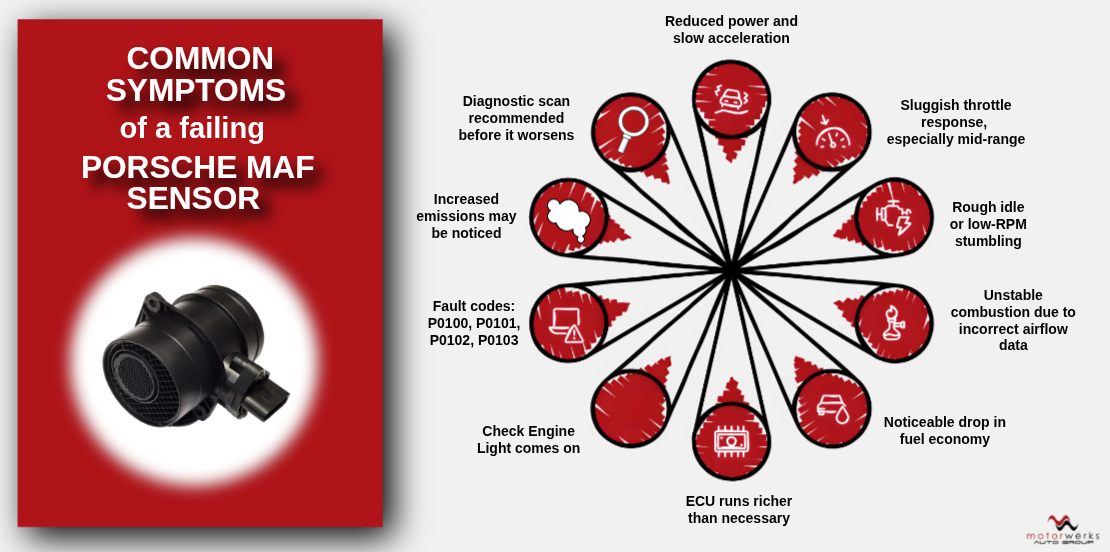
Porsche owners with MAF sensor problems typically notice several related symptoms that develop together. Reduced power and sluggish throttle response during acceleration are the most frequently reported complaints — the engine feels flat or hesitant, particularly in the mid-range. Rough idle or stumbling at low RPM is common, as the DME struggles to maintain stable combustion with inaccurate airflow data. Fuel economy often decreases noticeably as the ECU compensates for the incorrect readings by running richer than necessary. The Check Engine light will illuminate in most cases, storing a mass airflow-related fault code such as P0100, P0101, P0102, or P0103. Some Porsche drivers also notice increased emissions, which becomes relevant at Texas state inspection time. Any combination of these symptoms, especially paired with a CEL, warrants a diagnostic scan before the problem worsens.
What Causes MAF Sensor Failure in Porsche Models
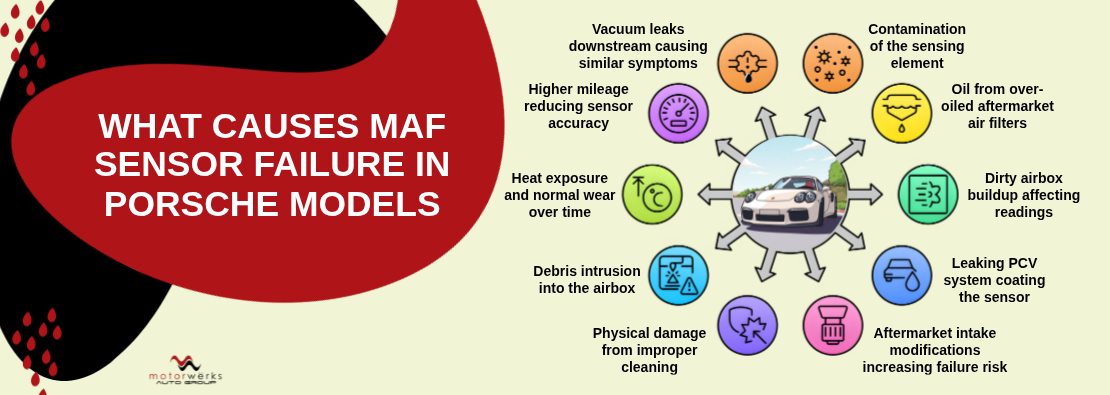
MAF sensors fail for several reasons in Porsche vehicles. The most common cause is contamination — the hot-wire or hot-film sensing element is extremely delicate, and oil residue from an over-oiled aftermarket air filter, dirty airbox, or a leaking PCV system can coat the sensing element and alter its readings. This is a particularly common failure mode on Porsche models that have had aftermarket intake modifications. Physical damage from an improperly cleaned airbox or debris intrusion is another cause. Over time, heat exposure and general wear degrade the sensor's accuracy even without contamination, which becomes more likely on higher-mileage 911s, Boxsters, Macans, and Cayennes. It's worth noting that MAF sensor symptoms can also be caused by vacuum leaks downstream of the sensor, so a proper diagnostic is essential before replacing parts.
Professional Diagnosis at Motorwerks Auto Group
When a Porsche arrives at our Humble shop with MAF-related symptoms, our technicians connect Porsche-specific diagnostic equipment to read fault codes and analyze live MAF sensor data. We compare actual airflow readings against expected values at various RPMs to determine whether the sensor is truly faulty or whether a vacuum leak or other issue is causing the symptoms. We also inspect the intake system for oil contamination, cracks, or loose connections. If the MAF sensor needs replacement, we use quality Porsche-compatible components and clear the fault codes before a test drive to verify the repair. We never recommend replacing parts without confirming the diagnosis — it's the Motorwerks way.
Schedule Your Porsche Diagnosis in Humble
If your Porsche is running rough, losing power, or showing a Check Engine light, don't let it linger. At Motorwerks Auto Group in Humble, our Porsche-experienced technicians have the tools to diagnose the problem right the first time. Call us at (346) 477-4103 or visit us at 2006 Rotary Dr, Humble, TX 77338 to book your appointment.
Frequently Asked Questions
Q: Can I clean a Porsche MAF sensor instead of replacing it?
A: Sometimes, if the sensor is contaminated rather than electrically failed. We assess the sensor condition before recommending cleaning vs. replacement.
Q: Will a bad MAF sensor damage my Porsche's engine if I keep driving?
A: An excessively rich condition caused by a failed MAF can foul spark plugs and increase catalytic converter wear over time. We recommend getting it diagnosed promptly.
Q: Can a dirty air filter cause MAF sensor symptoms?
A: A severely restricted air filter reduces airflow and can produce similar symptoms, but it won't generate the same DME fault codes as a failed MAF sensor. Both are worth checking.
Q: How long does a Porsche MAF sensor replacement take?
A: The replacement itself is often under an hour, but we always include a proper pre- and post-repair diagnostic scan to confirm the fix.